
Precisely Loaded
Horn and bandpass-loaded lows, Tetracoil LF behind custom phase plugs, midrange on the Coherent Midrange Integrator, compression drivers on planar waveguides — nothing fires straight off a baffle.
Every PK module boasts onboard amplification, DSP, robotics, and network identity — nothing is delegated to a rack down the hall. Connected, they comprise one collaborative infrastructure: controlled, measured, shaped, and re-aimed as a single system.
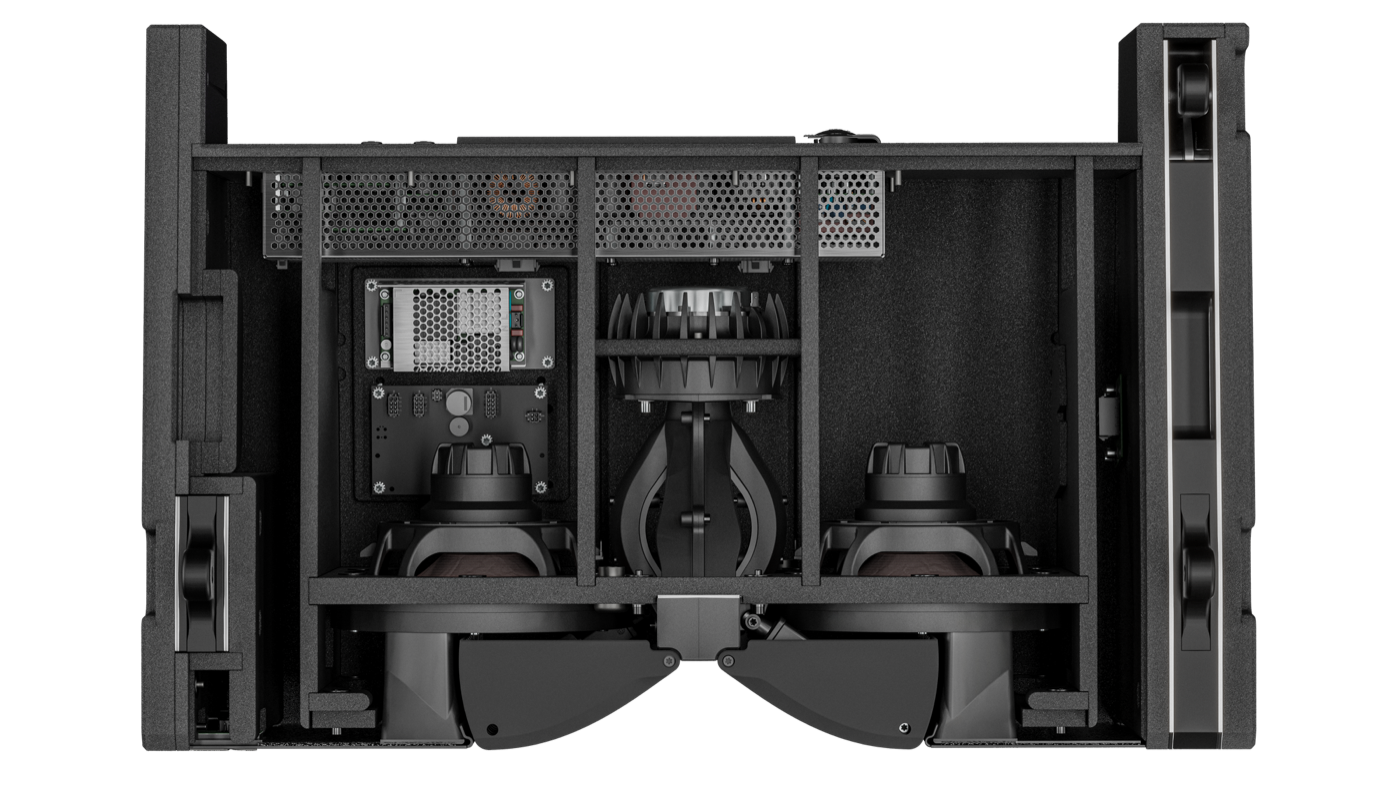
Integrated linear actuators inside every line source element. The vertical splay is set with 0.1° of precision and horizontal coverage spans 60° to 120° in 5° steps, symmetric or asymmetric, on each individual module — controlled from a laptop or mobile device, while the array is flown.
Patented Auto-Array technology uses network topology to discover every module on the network, then builds the arrays in the software automatically — whole systems online and ready to control in seconds.
Arrays fly straight on light, simple suspension frames — no angles awkwardly configured on the ground before anything goes up. Each module self-aligns as it's lowered and locks to the array automatically. Coverage parameters are applied robotically once the array is in the air.
Tilt an array down far enough and the top links go into compression — a result of tolerances in the rigging pins and unavoidable in any array. The top of the array goes convex and the coverage converges into a hot spot. PK .dynamics, paired with the robotics in every loudspeaker, adjusts each affected module by 0.3° to put the angle back exactly where it should be — so real-world results match the simulation exactly.
In a conventional line array, transducers are mounted to the front of the enclosure and radiate energy in an uncontrolled, spherical fashion. In a PK line source, no transducer radiates directly: every driver — low, mid, and high — is loaded through a phase plug or transforming device before its energy meets the air. The wavefront is shaped by the aperture, not the cone — precise directivity in the horizontal plane, and significantly improved rear rejection, independently measured at up to −20 dB behind the array.
Horn and bandpass-loaded lows, Tetracoil LF behind custom phase plugs, midrange on the Coherent Midrange Integrator, compression drivers on planar waveguides — nothing fires straight off a baffle.
The aperture — not the cone — defines the wavefront, so horizontal directivity is engineered and held consistent across the entire band.
Energy that never leaves the aperture never wraps behind the array — quieter stages, calmer microphones, and far less energy on whatever sits behind the rig.
Robotics dictate where the energy goes. Transducer architecture controls what arrives when it gets there. The patented CMI Waveguide is the second half of that story — the part that keeps adjacent modules summing as a single coherent source rather than as a stack of separate ones.
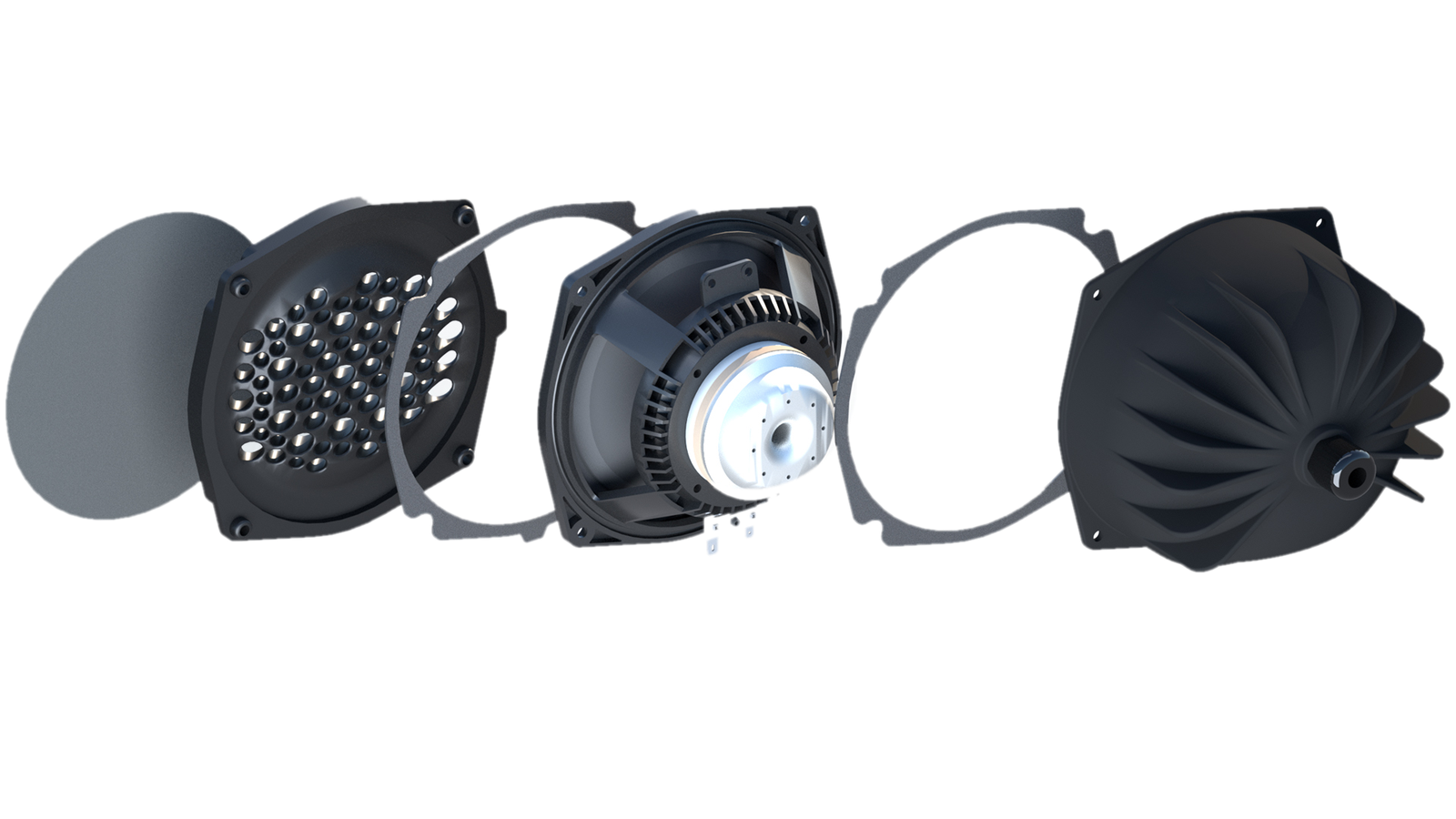
Vented 8" neodymium Tetracoil transducers with custom phase plugs manage low-frequency response.
A 3" coaxial dual ring radiator handles midrange and a 2" handles high frequency — mid and high leaving from a single point.
The Coherent Midrange Integrator is named in PK's patent portfolio alongside the multi-axis articulation mechanism.
An efficient, scalable, field-serviceable amplifier platform, consistent across every loudspeaker in the range. Four VE modules span 1,500 W to 4,000 W, with two to four channels per module — amplification that travels inside the enclosure it drives.
Milan is the open, deterministic audio networking standard built on IEEE AVB — synchronized media clocking, guaranteed bandwidth, and seamless redundancy are properties of the network itself, not an afterthought. And because it is certified across manufacturers rather than owned by one, a Milan system interoperates today and stays current as the ecosystem grows.

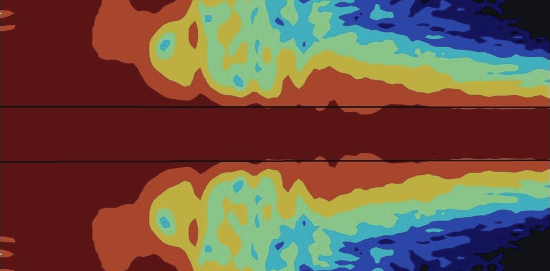
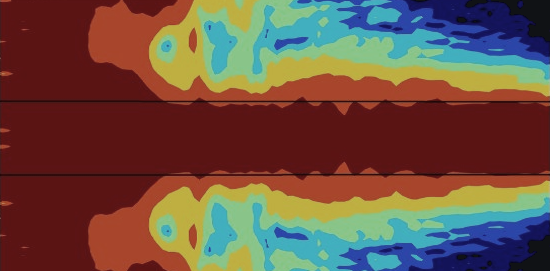
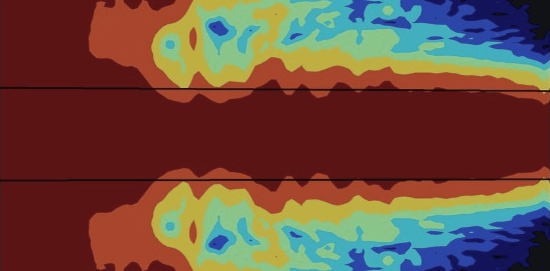
Constant-width horizontal coverage is achieved acoustically — designed into the enclosure, not corrected afterwards. Measured horizontal isobars for the T8 at 60°, 90° and 120°: the pattern holds its width across the entire spectrum, at every setting.
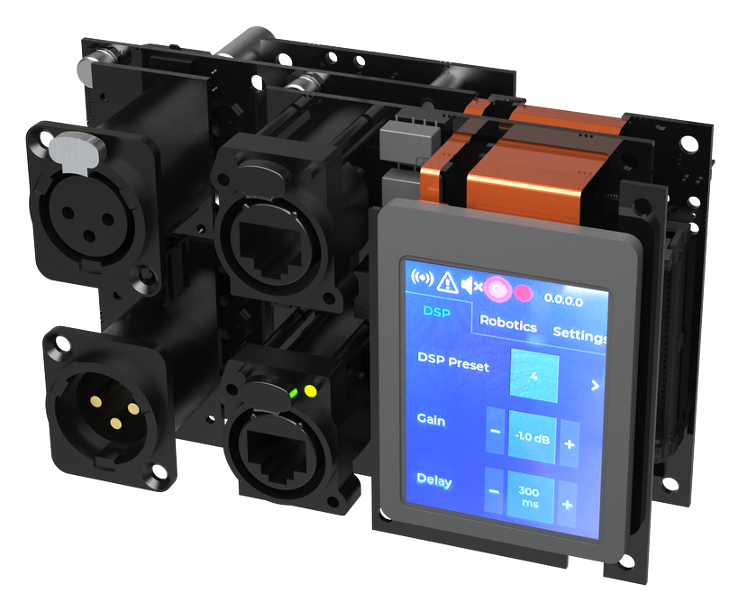
Local robotics and EQ control in every enclosure, not centralised in a rack down the hall. Processing lives where the sound is made. DSP in every module grants ultimate control of the system, making fine-tuned adjustments module by module instead of in groups of loudspeakers driven by a single amplifier.
AES70 is the open AES standard for controlling and monitoring networked audio devices. Where Milan carries the audio, AES70 carries the control — gain, presets, status, and diagnostics in vendor-neutral language that any AES70 controller can speak. That means PK loudspeakers integrate into wider control ecosystems without proprietary bridges, and system control rests on a published standard.
The category began at PK Sound. Three U.S. filings trace its evolution — the original Multi-Axis articulation mechanism, the Coherent Midrange Integrator waveguide, plus the next generation of loudspeaker robotics and Auto-Array.
Each number links to the full public filing.
The founding patent: splay angles between flown cabinets adjusted remotely by onboard actuators, with the pivot set behind the centre of gravity so the array re-articulates under full suspended load — plus pivoting waveguide walls for horizontal control.
US 9,033,098 · granted 2015The Coherent Midrange Integrator: precisely sized, angled apertures let midrange energy radiate through the high-frequency waveguide while staying acoustically invisible to the highs — so both bands leave every module as one coherent wavefront across up to 120°.
US 9,894,433 · granted 2018Next-generation robotics: one linear actuator driving a pivoting bell crank delivers double mechanical advantage at breakaway — where a flown array needs force most — at a fraction of the weight of dual-actuator designs.
US 2025/0238189 · patent pendingEach module identifies its neighbours over the network daisy chain and reports its position upstream, so the system knows every enclosure's order and angle in the array — and the deployment matches the simulation.
US 2025/0238189 · patent pendingFour rooms, two continents — Calgary, Buggenhout, Barcelona, and Colchester. Bring your drawings.